 Dym
Dym RollApps On-Demand Blocks, Data Availability, and Settlement
Updated -
Dym RollApps are application-specific rollups that use on-demand block production to reduce idle overhead while keeping application execution separate from data availability and Hub settlement. A sequencer orders transactions and produces blocks for the application. It publishes batches to a data availability (DA) network, then submits the corresponding state commitments to Dymension's Hub. Fewer unnecessary blocks can reduce operating work, although servers, publication fees, and settlement obligations remain. Local execution speed also differs from the time required to finalize a withdrawal.
Lengthening a RollApp's empty-block timeout can reduce idle block frequency without shortening its separate batch-publication interval.
Transaction Demand and Idle Block Costs
Incoming transactions give a RollApp sequencer work to include, while sparse demand leaves longer periods without user activity. Dymint supports on-demand block production for RollApps. A configurable idle timeout still allows empty blocks, so quiet periods do not imply a permanent halt. Traffic and timeout settings influence empty-block frequency. The economic benefit concerns work avoided during otherwise idle periods, with publication costs also depending on the batches the sequencer submits.
A slowly advancing block height can reflect low demand. The same symptom can also reflect a sequencer outage.
In a hypothetical configuration, a RollApp receives sporadic transactions, its operator lengthens the empty-block timeout, and the batch-submission interval stays unchanged. The operator asks whether this also accelerates Hub updates. The idle-time setting allows wider gaps between empty blocks when no other production trigger applies.
Batch publication keeps its separate schedule, and the sequencer still waits for DA acceptance before submitting a Hub update. Empty blocks occur less frequently during otherwise idle periods. The longer idle timeout does not itself speed up Hub updates.
Execution Rules and Approved RollApp Software
The RollApp Development Kit (RDK) supplies a Cosmos SDK-based framework for application-specific rollups. Dymint supplies sequencing and network communication around that application. The execution environment determines how transactions update balances, contracts, and other application state. Changing block timing leaves the application's execution rules intact.
The Ethereum Virtual Machine (EVM) and CosmWasm provide different contract runtimes. VM selection determines which application code a RollApp can execute.
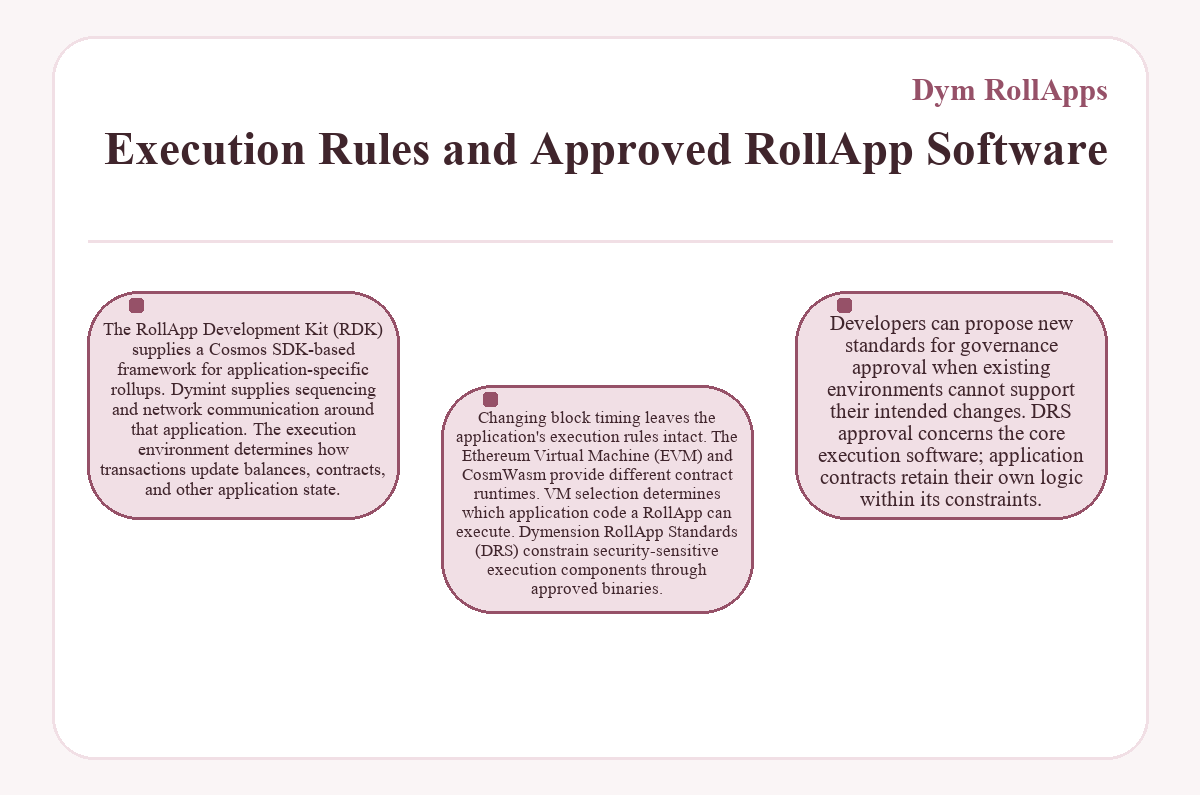
Dymension RollApp Standards (DRS) constrain security-sensitive execution components through approved binaries. Developers can propose new standards for governance approval when existing environments cannot support their intended changes. DRS approval concerns the core execution software; application contracts retain their own logic within its constraints.
Batch Publication Before Hub State Updates
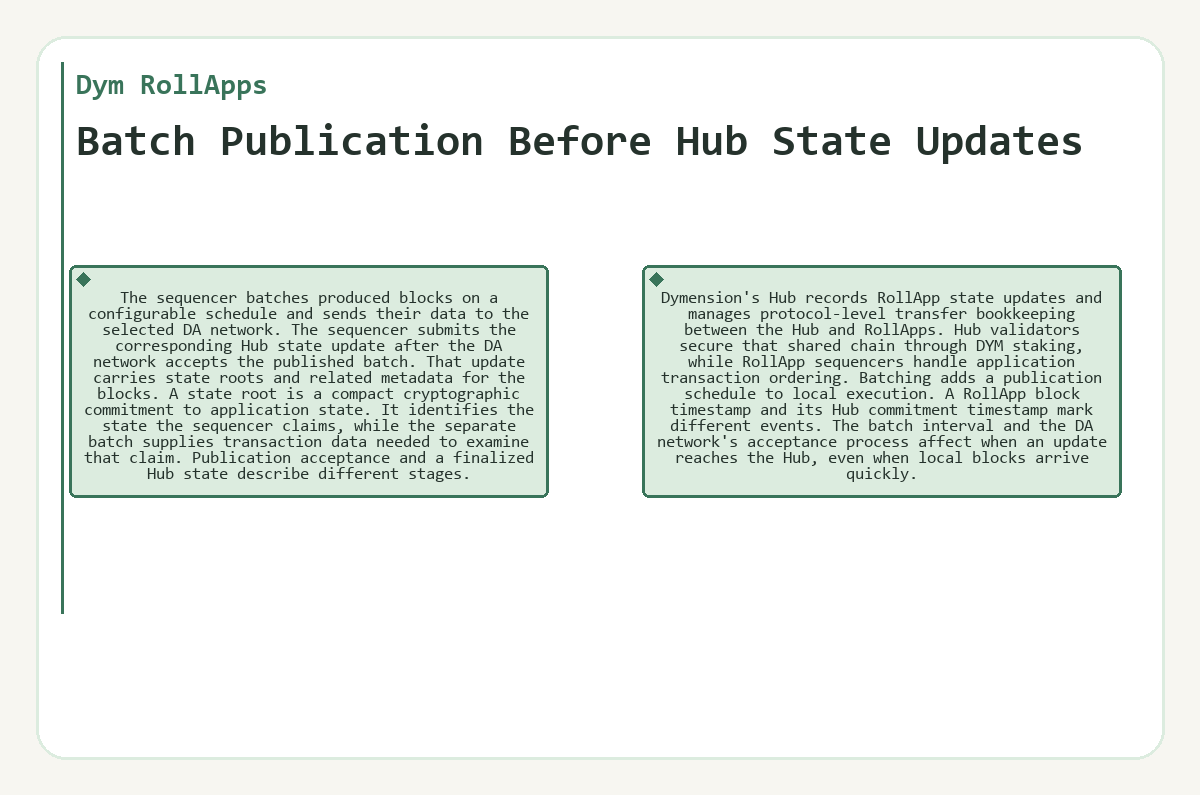
The sequencer batches produced blocks on a configurable schedule and sends their data to the selected DA network. The sequencer submits the corresponding Hub state update after the DA network accepts the published batch. That update carries state roots and related metadata for the blocks. A state root is a compact cryptographic commitment to application state. It identifies the state the sequencer claims, while the separate batch supplies transaction data needed to examine that claim. Publication acceptance and a finalized Hub state describe different stages.
Dymension's Hub records RollApp state updates and manages protocol-level transfer bookkeeping between the Hub and RollApps. Hub validators secure that shared chain through DYM staking, while RollApp sequencers handle application transaction ordering. Batching adds a publication schedule to local execution. A RollApp block timestamp and its Hub commitment timestamp mark different events. The batch interval and the DA network's acceptance process affect when an update reaches the Hub, even when local blocks arrive quickly.
Data Availability and Replayable History
Data availability lets verifying nodes obtain the block data needed to replay RollApp execution. Full nodes apply the relevant execution rules and compare their resulting state with the sequencer's commitment. A state root alone cannot reconstruct missing transaction inputs. DA inclusion proofs establish publication of particular data under the network's proof rules. They address where data appears; checking whether transactions produce the committed state requires execution as well.
Historical retention presents a separate requirement because DA full nodes may prune older transaction data. Archival nodes retain history beyond that pruning policy. Immediate availability checks and a complete application archive therefore serve different purposes. The chosen network's security model, publication costs, and data-retention arrangements matter to a RollApp's operation. Long-term reconstruction depends on retaining the required history, even when the original batch satisfied availability checks at publication.
Does a RollApp Block Mean a Withdrawal Is Final?
A RollApp block records local execution, while withdrawal finality follows the settlement rules applicable to that RollApp and transfer. The optimistic path uses a Hub-governed dispute period before ordinary finalization. Inter-Blockchain Communication (IBC) provides the transfer framework between the RollApp and Hub. Local block timing and the Hub's dispute-period parameters are separate inputs to withdrawal timing.
eIBC allows liquidity-backed fulfillment of eligible withdrawal requests ahead of ordinary state finalization. An operator can fulfill a request using authorized liquidity in return for a share of the priority tip. Earlier payment gives the withdrawing user access to funds while the underlying settlement process continues. The priority tip is a percentage of the transferred tokens. Fulfillment remains conditional on available authorized liquidity and the order's terms.
Trusted execution environment (TEE) attestations support a separate fast-finalization path. TEE-based fast finalization requires enablement at both Hub and RollApp levels. The protocol must accept the relevant attestation under its configured verification rules before it advances finalization.
Operating Costs Beyond Empty Blocks
A RollApp operating budget includes persistent infrastructure and publication charges alongside work saved during idle periods. Sequencer hosting, DA submission, Hub transaction fees, and maintained remote procedure call (RPC) access represent different cost inputs. Roller helps deploy and operate the services, including sequencers and full nodes. The operator's DYM sequencer bond also commits capital under the applicable protocol requirements. Bonded capital has a different role from fees consumed during operation.
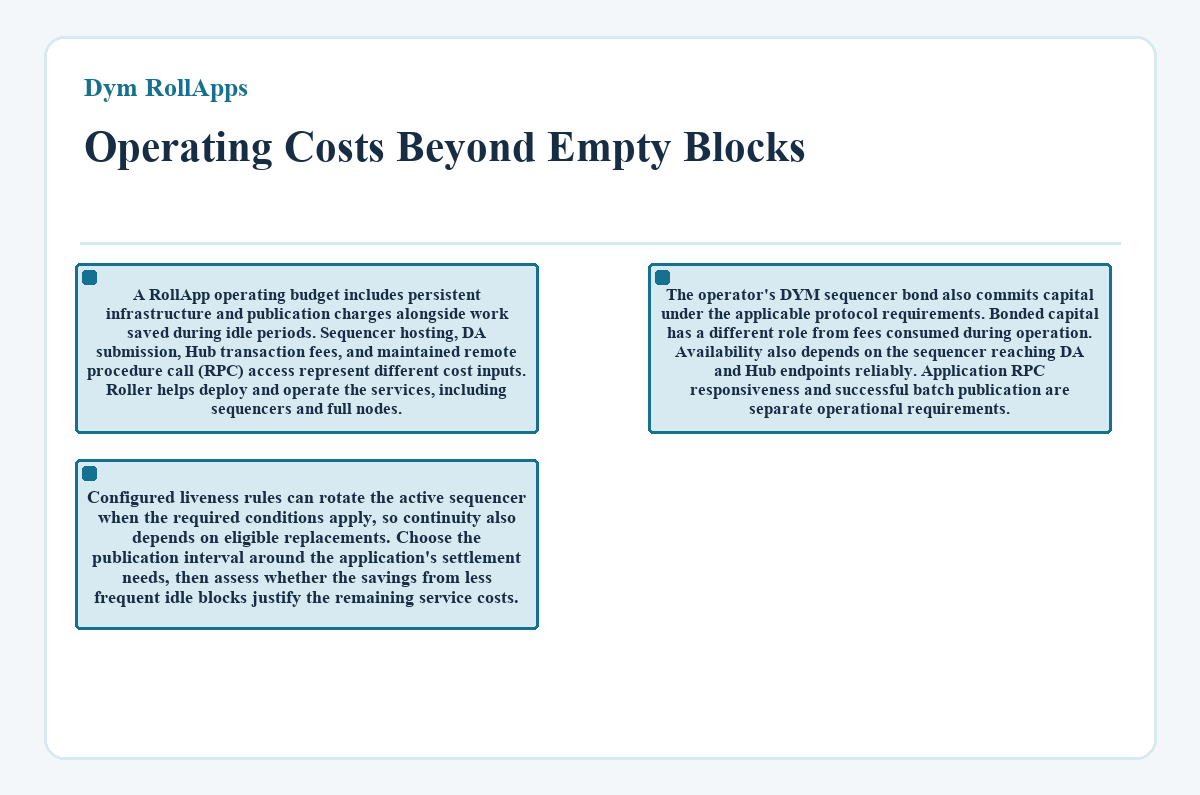
Availability also depends on the sequencer reaching DA and Hub endpoints reliably. Application RPC responsiveness and successful batch publication are separate operational requirements. Configured liveness rules can rotate the active sequencer when the required conditions apply, so continuity also depends on eligible replacements. Choose the publication interval around the application's settlement needs, then assess whether the savings from less frequent idle blocks justify the remaining service costs.
What to know about Dym RollApps
Can EVM Compatibility Make a RollApp an Ethereum Rollup?
A RollApp's EVM compatibility does not make Ethereum its settlement chain. The Ethereum Virtual Machine describes its contract runtime. Dymension's Hub handles settlement for the RollApp. The same runtime can serve chains with different settlement arrangements.
Is DYM Always the Transaction Fee Token Inside a RollApp?
DYM is not automatically the fee token inside every RollApp. The execution configuration determines the local fee denomination and minimum gas-price rules. Paying local transaction fees requires the RollApp's configured fee asset, even when the sequencer separately uses DYM for Hub operations.
Which Service Carries Transfer Messages Between a RollApp and the Hub?
A relayer carries IBC transfer messages between the RollApp and the Hub. It observes chain events and submits corresponding packets to the destination chain. The destination chain applies its protocol's verification rules and relevant finalization conditions before completing the transfer.
Who Can Operate a RollApp Created by Someone Else?
Operators can run a RollApp without being its creator, subject to that RollApp's sequencer eligibility rules. Creation records metadata and initial economic choices; operation involves sequencing infrastructure and Hub registration. A creator can choose an initial operator, and permissioned or permissionless eligibility changes who may take that role.
Does an IRO Token Mean Its RollApp Chain Is Already Live?
An Initial RollApp Offering (IRO) token can exist before its RollApp chain launches. The token phase can help bootstrap liquidity, while the running chain requires execution and sequencing infrastructure. Application transactions and Hub-to-RollApp transfers belong to the deployed-chain stage, with an operating chain and an enabled transfer connection.
Will on-demand Blocks Keep My RollApp Transactions Private?
A RollApp's block schedule does not determine its privacy properties. Confidentiality depends on what the application publishes and how its execution environment handles that data. Transaction data in a published batch may be accessible to verifying nodes. Changing idle-block or batch timing does not, on its own, hide those records.
Can Dymension Connect Replace a RollApp Sequencer?
Dymension Connect is a frontend integration framework, so it does not replace the sequencer's block-production role. It supports application-facing features such as wallet connections and cross-chain transfers. Dymint and the RollApp execution software handle chain operation, while the frontend provides the application's user interface.