 Dym
Dym Token Uses From Fees to Network Governance
Updated -
Dym, traded under the ticker DYM, is Dymension's native token for transaction fees, validator staking, and network governance. Liquid tokens pay ordinary transaction costs on Dymension's main chain, the Hub; delegated tokens help secure its proof-of-stake network. Dymension also connects application-specific blockchains called RollApps with settlement services, token liquidity, and launch funding. Holding the token, delegating it, and committing it to a liquidity pool therefore produce different rights and constraints.
In short: A total DYM holding can exceed the balance available for fees because delegated tokens remain outside the spendable Hub balance.
Liquid DYM for Hub Transactions
A liquid DYM balance pays the gas fee for an ordinary transaction on the Dymension Hub. Gas measures the processing work a transaction requires. Sending tokens, changing a delegation, and submitting a governance vote involve different messages, so their costs need not match. The transaction's gas allowance and applicable gas price determine its fee budget. A wallet's dollar valuation of the account does not establish how much native currency remains spendable.
Delegated tokens cannot cover an ordinary fee directly. Pending staking rewards also differ from an available bank balance. Fee-exempt messages exist within specific protocol flows, including supported IRO operations, but that exemption does not extend automatically to staking or transfers. RollApps have their own execution economics and may use another fee token. A Hub gas charge and a RollApp application charge consequently describe different costs.
The Settlement Layer Behind RollApps
The Dymension Hub provides a shared settlement layer for RollApps, while each RollApp executes its own application transactions. Settlement coordinates the accounting of transfers between the Hub and those chains. Validators secure the Hub, and RollApp operators run sequencers responsible for ordering and processing RollApp transactions. A sequencer publishes transaction data to a data-availability network before submitting state commitments to the Hub. Those commitments describe the RollApp's state; the external data lets other nodes examine the underlying transactions.
Settlement, execution, and data availability remain separate responsibilities. Sequencers can bond DYM on the Hub to support their right to propose RollApp state updates. That bond is separate from DYM delegated to a Hub validator. Application performance and transfer finality also depend on the particular RollApp and its settlement configuration.
Validator Delegation and Network Security
Delegating DYM assigns stake to a validator participating in Dymension's proof-of-stake system. Active validators sign Hub blocks and participate in consensus. Delegators share eligible rewards, which include new token issuance and Hub transaction fees. Validator commission reduces the rewards reaching a delegation; it is a charge against rewards, separate from the transaction fee an account pays to delegate.
Reward eligibility follows the validator's active status. A validator outside the active consensus set does not earn consensus rewards simply because tokens remain delegated to it. Issuance, total eligible stake, fee revenue, and commission all affect the amount a delegation earns. An annual percentage displayed by an interface estimates an evolving reward stream.
Slashing can reduce delegated principal when a validator commits a punishable consensus fault. Undelegating bonded stake starts an unbonding process governed by network parameters. The relevant unbonding entry records its completion time; beginning that process does not immediately restore a spendable balance.
Who Can Vote in Dymension Governance?
Dymension L1 governance assigns voting power to native DYM stakers. A delegator who does not cast a vote can inherit the chosen validator's vote. Validator selection consequently affects representation as well as network security. Keeping tokens liquid does not establish the equivalent voting weight.
Proposals can adjust protocol parameters, authorize community spending, or coordinate software upgrades. Their actual messages determine the requested change, and the protocol's voting rules determine whether a proposal passes. Participation grants no ownership of a RollApp creator's business or automatic claim on application revenue.
A Fee Reserve Beside Bonded DYM
A delegation can leave part of an account's native balance available for later transaction fees. Using hypothetical amounts, an unlocked Hub account starts with 46.86 DYM, delegates 42.10 DYM to an active validator, and pays a 0.006 DYM transaction fee. Assume no existing delegation, pending rewards, or other balance changes.
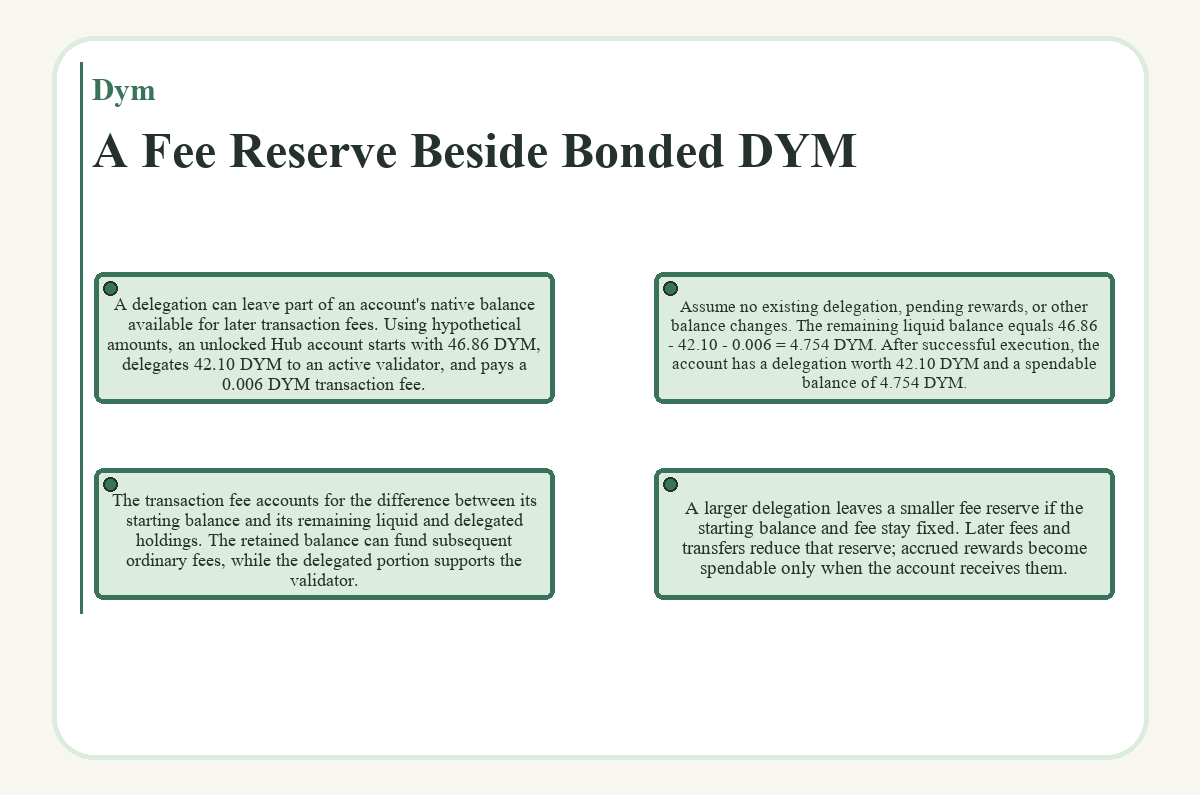
The remaining liquid balance equals 46.86 - 42.10 - 0.006 = 4.754 DYM. After successful execution, the account has a delegation worth 42.10 DYM and a spendable balance of 4.754 DYM. The transaction fee accounts for the difference between its starting balance and its remaining liquid and delegated holdings.
The retained balance can fund subsequent ordinary fees, while the delegated portion supports the validator. A larger delegation leaves a smaller fee reserve if the starting balance and fee stay fixed. Later fees and transfers reduce that reserve; accrued rewards become spendable only when the account receives them.
How Does DYM Supply Change?
DYM supply changes through new issuance and token burning, while unlocking changes when existing allocations can circulate. These mechanisms affect different quantities.
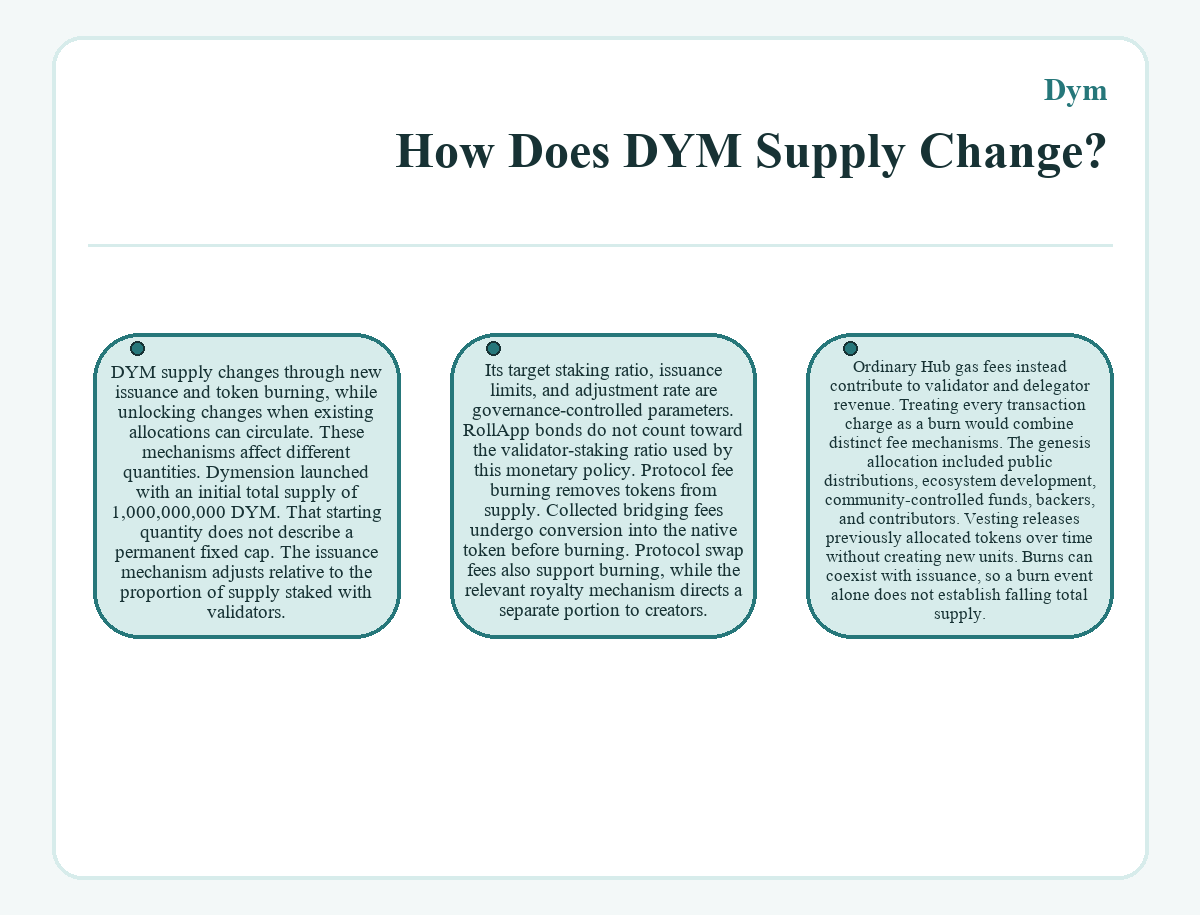
Dymension launched with an initial total supply of 1,000,000,000 DYM. That starting quantity does not describe a permanent fixed cap. The issuance mechanism adjusts relative to the proportion of supply staked with validators. Its target staking ratio, issuance limits, and adjustment rate are governance-controlled parameters. RollApp bonds do not count toward the validator-staking ratio used by this monetary policy.
Protocol fee burning removes tokens from supply. Collected bridging fees undergo conversion into the native token before burning. Protocol swap fees also support burning, while the relevant royalty mechanism directs a separate portion to creators. Ordinary Hub gas fees instead contribute to validator and delegator revenue. Treating every transaction charge as a burn would combine distinct fee mechanisms.
The genesis allocation included public distributions, ecosystem development, community-controlled funds, backers, and contributors. Vesting releases previously allocated tokens over time without creating new units. Burns can coexist with issuance, so a burn event alone does not establish falling total supply.
Address Formats and Interchain Balances
Dymension supports hexadecimal addresses beginning with 0x and Bech32 addresses using the dym prefix. An address format describes how an account identifier appears. It does not, by itself, select the blockchain receiving a transfer. The destination network and the sending interface's accepted address format both matter, including when a custodian restricts withdrawal formats.
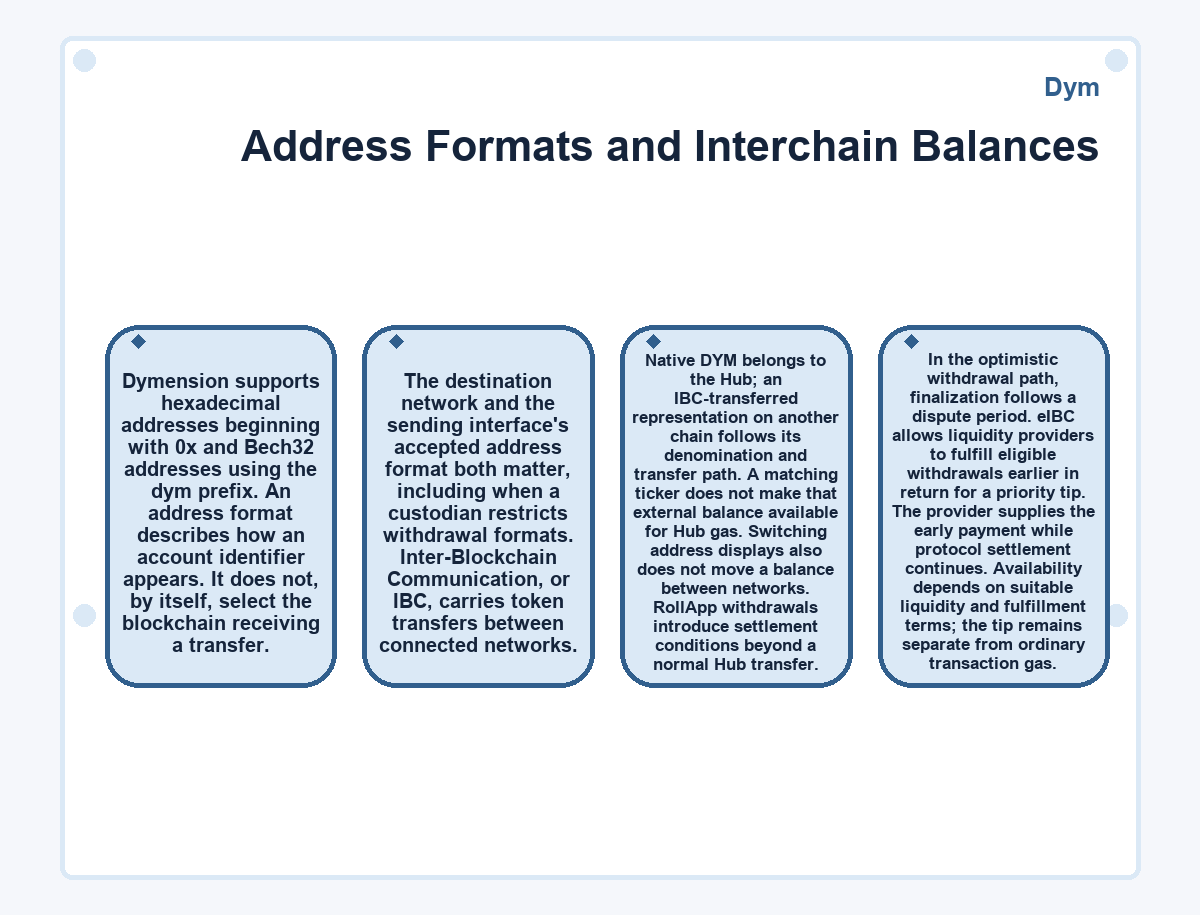
Inter-Blockchain Communication, or IBC, carries token transfers between connected networks. Native DYM belongs to the Hub; an IBC-transferred representation on another chain follows its denomination and transfer path. A matching ticker does not make that external balance available for Hub gas. Switching address displays also does not move a balance between networks.
RollApp withdrawals introduce settlement conditions beyond a normal Hub transfer. In the optimistic withdrawal path, finalization follows a dispute period. eIBC allows liquidity providers to fulfill eligible withdrawals earlier in return for a priority tip. The provider supplies the early payment while protocol settlement continues. Availability depends on suitable liquidity and fulfillment terms; the tip remains separate from ordinary transaction gas.
DYM Liquidity in the Embedded Exchange
Dymension's embedded automated market maker, or AMM, connects token liquidity through pools. DYM serves as a base asset in standard pools, whose paired reserves follow a constant-product relationship. Multi-hop routing can connect different pool assets in one swap transaction. Pool reserves and trade size affect the execution price, independently of the separately charged swap fees.
Liquidity providers receive pool shares, also called LP tokens, representing their proportional claim on pooled assets. Swap fees retained in a pool increase the assets those shares represent. Additional pool incentives require the applicable LP-token bonding conditions. A pool position exposes its holder to changes in both assets and impermanent loss relative to holding them separately. Pool-share bonding therefore has different economics from delegating the native token to a validator.
RollApp Funding Through Initial Offerings
A DYM-denominated Initial RollApp Offering, or IRO, uses the native token to purchase prelaunch tokens along a configured bonding curve. The curve governs how purchases and sales affect pricing. The creator's fundraising target and launch conditions shape the offering. A quoted token price establishes neither a launch date nor an operating blockchain. The purchased IRO token is a different asset from the currency funding it.
For offerings using native-token conversion, launching the RollApp enables holders to exchange prelaunch tokens for native RollApp tokens at a 1:1 token ratio. That ratio describes token units, without promising an unchanged market value. Raised funds and reserved tokens can seed an AMM pool. The v4 offering implementation also supports other fundraising denominations and configurable creator allocations, so DYM funding and a single allocation pattern are not universal across every plan.
Endorsements and Creator Royalties
Endorsements use DYM staking weight to direct protocol incentive streams toward eligible RollApps. Governance proposals set network policy; endorsement votes steer incentive allocations within the relevant program. The v4 sponsorship model restricts endorsement votes to RollApp reward destinations, also called gauges. Its available targets differ from the earlier pool-targeting model.
Pool-targeted endorsements directed incentives toward liquidity pools, where bonded LP positions qualified for distributions. That mechanism does not make a validator delegation a pool share. The active protocol mode determines the permitted endorsement targets, while each incentive stream governs its own eligible recipients.
Creator royalties provide a separate DYM-denominated distribution channel. Eligible IRO and pool trades generate a royalty component alongside protocol fee burning. The documented Mainnet royalty model distributes these payments directly to RollApp creators. A staker's endorsement does not confer ownership of the royalty stream. Extra rewards a RollApp team offers follow that team's eligibility rules.
Common questions, answered
Is Native DYM an ERC-20 Token?
Native DYM is the Hub's native currency, not an ERC-20 contract token on Ethereum. An Ethereum-style wallet address can identify a Dymension account without placing its balance on Ethereum. A contract-based representation on another network would have its own network and contract details. Adding a token contract cannot replace selecting the correct chain, and an external representation does not automatically fund the Hub account with native gas.
Which Unit Does a Raw Dymension Balance Use?
Dymension's native base denomination is adym, and one DYM equals 1,000,000,000,000,000,000 adym. The token has 18 decimal places, even when a wallet displays fewer digits. A raw integer needs its denomination metadata before you interpret it as a token amount. Another denomination can identify a different asset. Wallet display amounts and raw transaction values should be compared only after converting them into the same unit.
Can a DYM Balance on an Exchange Vote Directly?
An exchange account balance alone does not give you direct control of a Dymension governance vote. The chain recognizes native staked tokens and their controlling account, while an exchange maintains its own customer balance records. A custodian may provide a voting service under its participation terms. Its displayed balance does not establish that your own onchain account holds a delegation or controls the vote attached to the custodian's stake.
When Do DYM Staking Rewards Increase My Delegated Stake?
Staking rewards increase delegated stake when the account actually delegates those rewards. Reward accrual, withdrawal to a spendable balance, and delegation describe different accounting changes. A wallet may combine supported messages or offer a restaking service, so those changes do not necessarily require separate clicks. The resulting delegation record establishes the new stake amount. An estimated reward figure or a withdrawal by itself does not establish compounding.
Will an Onchain DYM Transfer Reveal My Balance?
An ordinary Dymension transfer reveals public account addresses, allowing others to inspect their native onchain balances. Transaction history also exposes transferred amounts and fees, even when the wallet publishes no personal name. Changing between hexadecimal and Bech32 address formats does not create a private account or hide the underlying transaction history. A public address reveals ledger information; a recovery phrase exposes control of the wallet.
Which Wallets Does Dymension Connect Support?
Dymension Connect supports Keplr, MetaMask, and Leap for wallet connections. These integrations connect a wallet to a selected network; a connection alone does not move tokens between chains or grant every RollApp the same execution features. A particular application may expose only part of the integration's capabilities. Its supported network and transaction types determine whether the connected wallet can authorize the desired action. A successful connection alone establishes no transfer or delegation.